

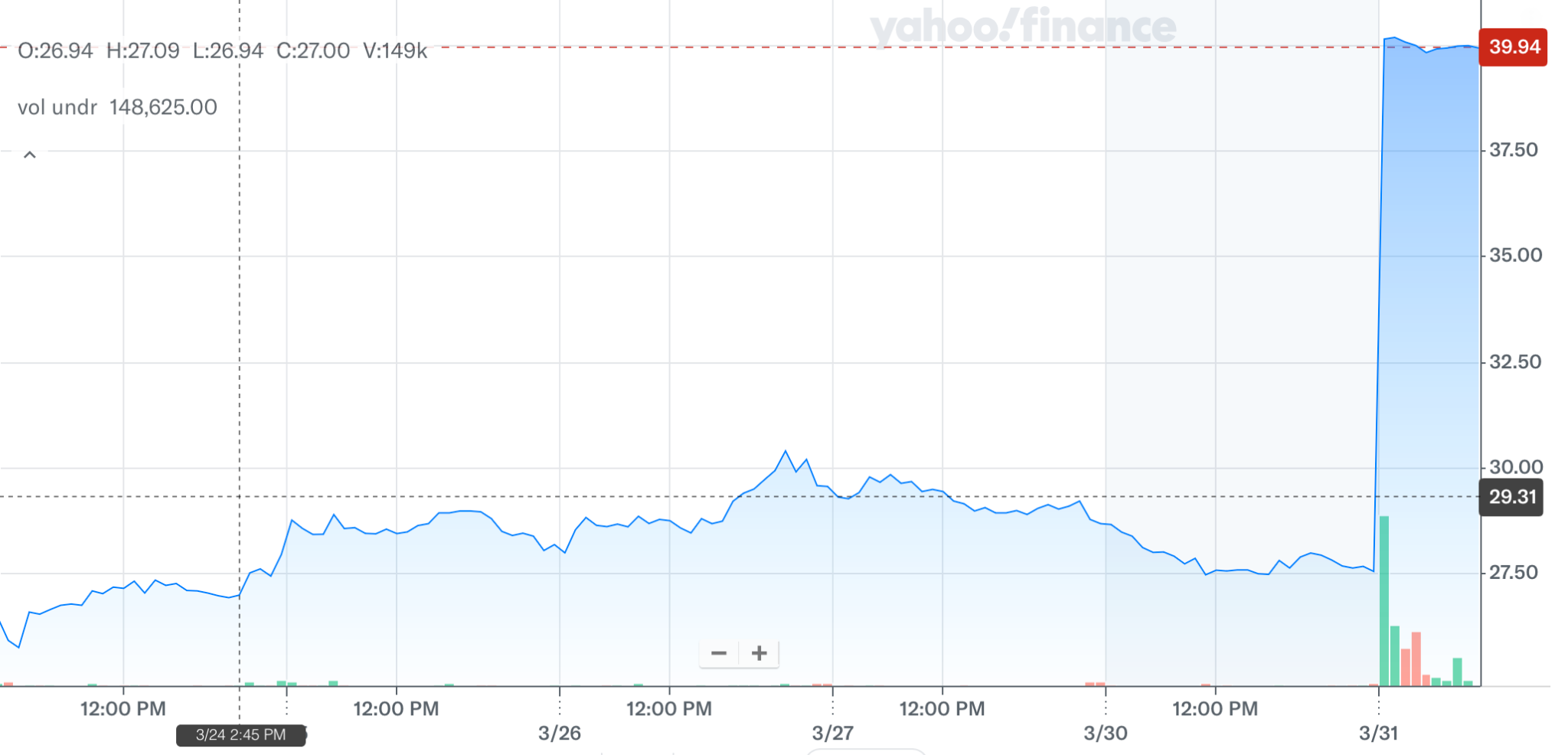
Great news for Centessa (NASDAQ: CNTA) shareholders today.
The company is being acquired by Eli Lilly (NYSE: LLY) for $38 per share, with a potential contingent value right worth up to $9 per share. That values the deal at around $6.3 billion upfront and up to $7.8 billion including milestones.
Those who have been long on Centessa were well rewarded today for their patience.
If you’re unfamiliar, Centessa is developing a new class of drugs targeting orexin receptors (the system that effectively controls the brain’s sleep-wake cycle). Its lead candidate is already in mid-stage trials for narcolepsy and related disorders.
What makes this interesting is that this isn’t just designed to treat symptoms. It actually directly controls wakefulness at the source. And Eli Lilly wanted in.
Chasing neuroscience
After building a massive franchise around obesity and metabolic drugs, Eli Lilly is now expanding into neuroscience and sleep medicine. This is a space with:
- High unmet need
- Limited innovation
- And real commercial upside
The deal itself underscores the conviction, here.
And to be sure, this isn’t just about one drug. It’s about platform control.
Centessa isn’t bringing a single asset. It’s bringing an entire pipeline of orexin-based therapies that could extend beyond narcolepsy into broader neurological and psychiatric conditions.
That creates optionality, and optionality is where biotech valuations expand.
Indeed, Contessa was in an excellent position to be acquired, as it offers Eli Lilly an opportunity to generate significant income from Centessa’s pipeline.
What Eli Lilly is really buying
Right now, the narcolepsy drug market is relatively small. It’s valued at around $2.5 billion globally today and is forecast to reach $6 billion to $8 billion over the next decade.
On its own, that’s not a blockbuster category. But that’s not what Lilly is buying.
The real opportunity is expanding the category.
Orexin-based therapies don’t just treat narcolepsy. They target the core sleep-wake mechanism, which opens the door to:
- Idiopathic hypersomnia
- Sleep apnea (adjacent overlap)
- Insomnia
- Broader neurological disorders
That’s why the total sleep disorder treatment market is much larger. We’re talking roughly $25 billion in 2026, and growing to around $35 billion by 2031. That’s the real total addressable market.
Some analysts now believe peak sales for Centessa’s lead orexin drug could clock in at around $2.3 billion a year. And that’s just for one indication.
With expanding indications, this could capture at least 10-15% of the sleep disorder market. That’s between $3 billion and $5 billion in annual revenue potential.
Given what Eli Lilly paid here, if this works out, the acquisition could prove incredibly fruitful.





Publication Date
March 31, 2026
Category
Healthcare / Biotech

Jeff Siegel
Senior Content Contributor