
Check out this headline …
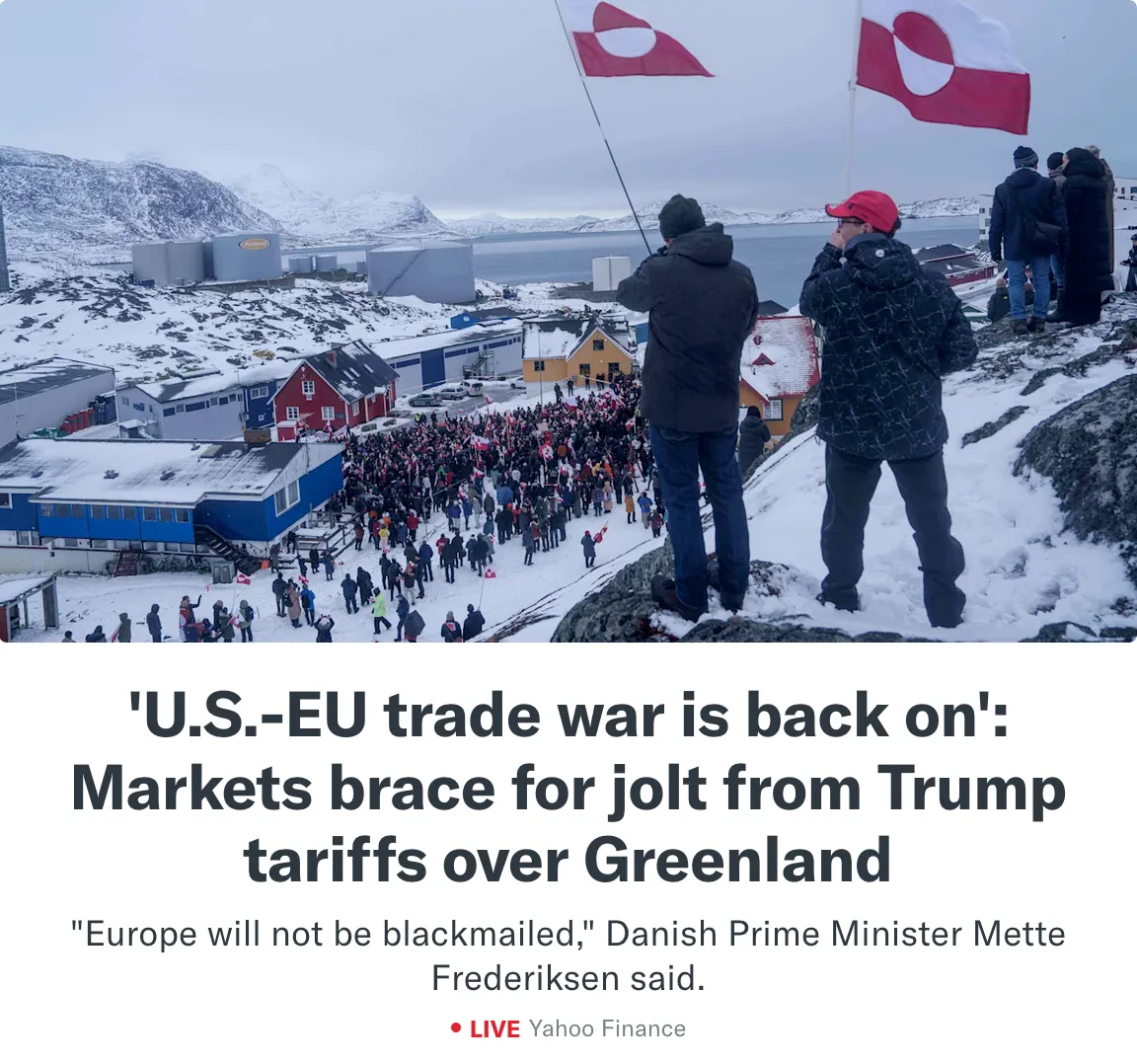
Indeed, it’s going to be a bumpy ride this week.
To be sure, there’s nothing political in these pages.
My job is not to take a position on policy. My job is to provide you with the information you need to build and protect your wealth. Which is why you’re reading this now.
The Inconvenient Truth about Tariffs
President Trump has returned with his tariff threats in response to NATO defending Greenland from the threat of a potential U.S. invasion.
The whole thing is being dressed up as “toughness” by President Trump, but markets don’t trade slogans; they trade math. And the math on broad tariffs against the European Union doesn’t pencil out in favor of the U.S.
Indeed, the EU isn’t some fringe trading partner. It’s one of the most deeply integrated economic counterparts the U.S. has.
American manufacturers rely on Europe for advanced machinery, specialty components, chemicals, pharmaceuticals, and industrial inputs that simply aren’t replaceable overnight. Slap tariffs on those imports and you don’t punish Europe, you raise costs for U.S. businesses, squeeze margins, and quietly pass the bill to American consumers through higher prices. Tariffs are inflationary by design, whether politicians admit it or not.
Then consider supply-chain damage.
Modern manufacturing is a precision system built for efficiency, not political theater.
Tariffs force companies to re-route sourcing, duplicate production, and hold excess inventory. That’s not “reshoring strength” – that’s destroying return on capital. Over time, it makes U.S. firms less competitive globally, especially against Asian competitors who may retain cleaner access to European suppliers. And retaliation is never theoretical, either.
The EU has a long track record of responding surgically – targeting U.S. exports where it hurts most: agriculture, aerospace, industrial goods, and iconic consumer brands. When that happens, U.S. exporters lose access to one of the wealthiest markets in the world. Jobs, revenues, and investment follow that loss out the door.
Markets understand this dynamic instinctively …
Trade uncertainty freezes capital spending, delays hiring, and raises risk premiums. You see it in higher volatility, lower multiples, and weaker confidence across trade-exposed sectors. Capital hates unpredictability, and tariffs manufacture it.
So now you have to ask yourself which stocks will be the winners as a result of this act of aggression from the U.S., and which will be the losers?
The Losers
The most immediate losers are companies caught in the crossfire of transatlantic supply chains.
European exporters into the U.S. take the first hit. Automakers like BMW (DE: BMW), Mercedes-Benz (OTCBB: MBGYY), and Volkswagen (OTCBB: VWAGY) rely heavily on U.S. demand for higher-margin vehicles. Tariffs raise prices, weaken demand, and compress margins. This is a toxic combination in a capital-intensive industry.
Luxury goods companies face a similar squeeze. Brands such as LVMH (OTCBB: LVMUY) and Kering (PA: KER) derive a significant portion of profits from U.S. consumers. Tariffs don’t kill demand outright, but they erode it slowly, while forcing discounting that damages brand economics.
On the U.S. side, exporters vulnerable to EU retaliation often get blindsided. Agriculture names, aircraft suppliers, and industrial exporters historically find themselves targeted. These include, but are not limited to:
- Archer-Daniels-Midland (NYSE: ADM)
Heavy exposure to global grain, oilseed, and ag export flows. EU tariffs can directly impact volumes and margins. - Bunge (NYSE: BG)
Significant European and global trade exposure in soybeans, corn, and edible oils. - Corteva (NYSE: CTVA)
Seeds and crop protection products sold internationally; trade friction can slow demand and pressure pricing. - Deere & Company (NYSE: DE)
Farm equipment demand is highly sensitive to export-driven farm income and retaliatory tariffs.
- Boeing (NYSE: BA)
Direct exposure to EU tariffs, regulatory friction, and retaliatory trade actions affecting aircraft deliveries. - Howmet Aerospace (NYSE: HWM)
Makes critical aircraft components with international customers and supply chains.
- Caterpillar (NYSE: CAT)
Global manufacturing footprint with meaningful EU exposure on both sourcing and sales. - Illinois Tool Works (NYSE: ITW)
Broad exposure to industrial end markets with European revenue sensitivity. - Emerson Electric (NYSE: EMR)
Automation and control systems sold globally; tariffs pressure margins and order flow. - Honeywell (NYSE: HON)
Aerospace and industrial exposure tied to EU demand and regulatory frameworks.
The Winners
Tariffs don’t just destroy value; they redirect capital.
Companies with domestic supply chains, domestic customers, and essential services often emerge stronger as capital rotates away from global trade exposure.
U.S. defense and security firms benefit structurally from rising geopolitical friction. Names like Lockheed Martin (NYSE: LMT) and Northrop Grumman (NYSE: NOC) operate largely outside consumer demand cycles and face little tariff risk on inputs relative to their pricing power and government-backed revenue.
Infrastructure and energy logistics also tend to outperform. Midstream operators such as ONEOK (NYSE: OKE) generate cash flows tied to domestic energy movement, not global trade flows. Their revenues are contractual, inflation-aware, and largely insulated from tariff noise.
Finally, blue-collar, domestic service businesses (utilities, infrastructure maintenance, emergency services, and regulated operators) quietly benefit as capital seeks predictability over exposure. These businesses don’t rely on cross-border efficiency; they rely on necessity.
To be sure, tariffs don’t reward nationalism; they reward simplicity. This is when the market begins to favor:
- Domestic revenue
- Contracted cash flow
- Pricing power
- Low input volatility
And penalizes:
- Complex global sourcing
- Thin margins
- Discretionary demand
- Export dependence
Bottom line: EU tariffs are a headwind for globalized manufacturers and exporters, but a tailwind for domestic, essential, cash-flow-driven businesses. Investors don’t need to predict policy outcomes. They just need to position around where earnings become fragile and where they become scarce.
Capital always follows durability. Tariffs simply accelerate the sorting process.
Invest accordingly.





Publication Date
January 18, 2026
Category
Industrials

Jeff Siegel
Senior Content Contributor